
After this winter, I’m sure many of us are eager for warmer weather. Thankfully, nature is not constrained by our calendars, and one can find glimpses of spring well before the equinox on March 20th. The gray of the forest will soon take on a subtle rosy tint as buds swell. The alien flowers of skunk cabbage will bloom in swamps. Every sunny day has a little more birdsong than the last. Soon, the skies will be filled with the northward spring migration. One of the earliest returnees is the mysterious—and slightly goofy—woodcock, known for its remarkable display.
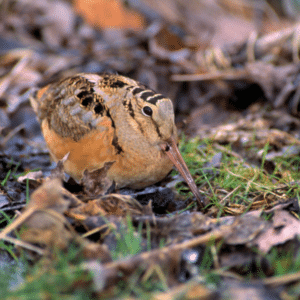
The American woodcock, scolopax minor.
This small, plump bird is rarely seen. Woodcocks are typically secretive, lurking under brush in damp woods and swamps, concealed by ornately patterned camouflage. Here, they feed on worms and other invertebrates, probing the soil with their long beaks. Unlike most birds, their beaks are flexible, and they can maneuver the tip, seizing subterranean prey. Curiously, the woodcocks can be seen rocking back and forth while hunting. It is believed that this behavior is a form of “worm charming”, where the motion encourages worms to move closer to the surface. Having their face buried in the muck would make them vulnerable to predators, if not for their large and strangely configured eyes. Set far back on their head, they have nearly 360° vision. These features, and their very short tail, give them a sort of top-heavy look. A story attributed to the Seneca Nation tells of how the woodcock was assembled from the leftover parts of many creatures. It’s a fitting description; despite being forest ground birds, they are actually related to sandpipers and shore birds.
The woodcock’s unusual anatomy is complemented by their many odd names, such as timberdoodle, bogsucker, mudsnipe, and Labrador twister. The exact origin of their scientific name, Scolopax minor, is uncertain, as it comes from similar words in Latin and Greek, meaning simply “woodcock.” Some possible Greek etymologies are skoli opos, “skew-eyed” or skalops, for “dig-face.” Sounds about right to me.
Beginning with their return in February, woodcocks perform a dazzling mating ritual throughout the spring. Described by Aldo Leopold as a “skydance,” this takes place at dawn and dusk, in fields, bogs, or open woods. Males start on the ground, repeatedly making a high pitched nasal call, described by birders as peent or bzeep. They then launch themselves high into the air, as much as 350’, before descending in a wild, spiraling free-fall. Air rushing through specialized feathers produces a strange liquid whistling, accompanied by vocal chirps, all becoming increasingly complex as they near the ground. There is some debate about which sounds are vocal and which are from their feathers. Ornithologist David Sibley noted how difficult this is to study, since the display occurs in near-darkness at incredible speeds.
Unfortunately for the woodcock, their agility made them a favorite target of sport-shooting. This, combined with loss of habitat, caused their numbers to plummet; they are designated a species of “Greatest Conservation Need” in Massachusetts. Thankfully, their numbers have stabilized in the last decades. The Wareham Land Trust would like to host a woodcock walk, but have yet to locate any. If you have seen them, please report your sightings to community@warehamlandtrust.org, and we can help more people see this seasonal spectacle.
By Justin Cifello, Lant Trust Member and Volunteer